Currently Empty: R0.00

UF Membrane Pore Size Explained: Why It Matters
UF membrane pore size is one of the most important factors determining how an ultrafiltration system performs. Although many people know that ultrafiltration removes bacteria and suspended solids, fewer understand that the membrane’s microscopic pores are responsible for separating contaminants from clean water.
The size of these pores determines which particles are retained and which continue through the membrane. Therefore, understanding UF membrane pore size helps homeowners, businesses, and industries choose the right water treatment solution for their specific water quality requirements.
What Is UF Membrane Pore Size?
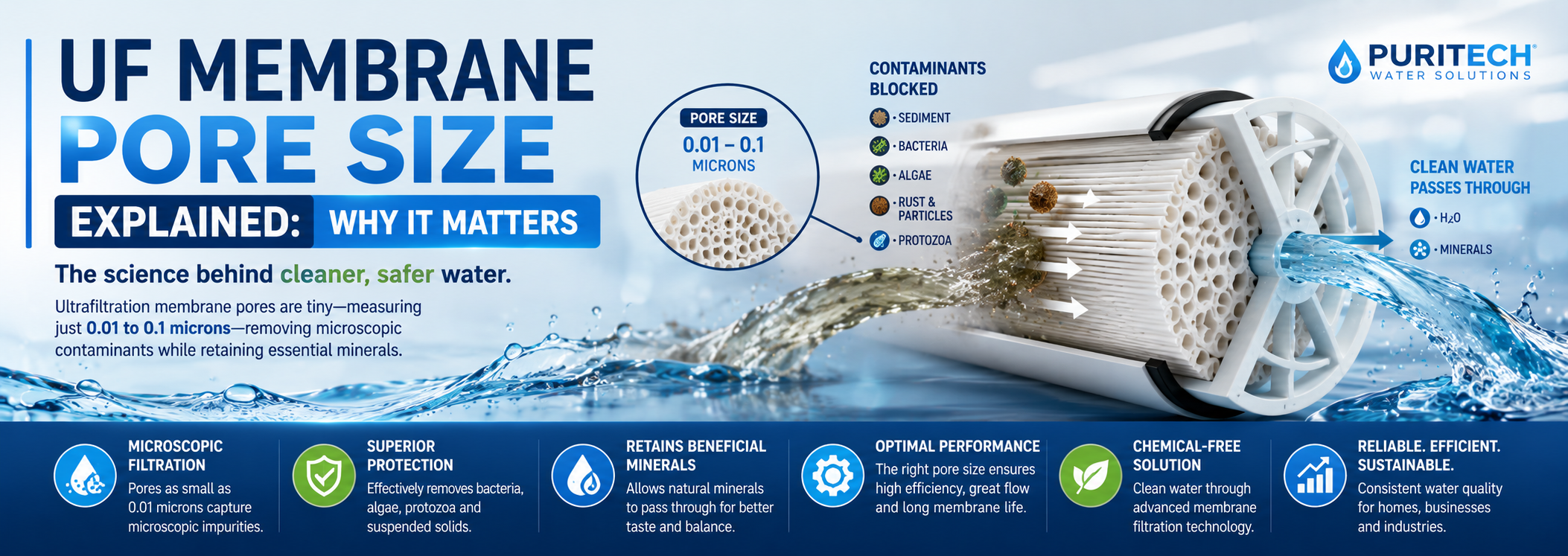
An ultrafiltration membrane contains thousands of hollow fibres with microscopic openings called pores.
These pores are incredibly small, typically ranging between the following:
0.01 and 0.1 microns (µm)
To put this into perspective:
- A human hair is approximately 70 microns wide.
- Fine sand measures around 90 microns.
- Most bacteria range from 0.2 to 5 microns.
Consequently, ultrafiltration membranes can remove contaminants that are invisible to the naked eye.
Why UF Membrane Pore Size Is Important
The membrane acts like a microscopic sieve.
Water molecules and dissolved minerals pass through the pores, while larger contaminants remain outside the membrane.
As a result, UF membrane pore size directly affects:
- Filtration efficiency
- Water clarity
- Bacteria removal
- Membrane performance
- Flow rate
- System reliability
Choosing the correct membrane pore size ensures the system delivers the desired level of filtration without unnecessarily restricting water flow.
What Contaminants Are Larger Than UF Membrane Pores?
Because the pores are extremely small, ultrafiltration removes many suspended contaminants.
These include:
Suspended Solids
The membrane captures the following:
- Sand
- Silt
- Fine sediment
- Rust particles
- Pipe scale
Bacteria
Most bacteria are significantly larger than UF membrane pore sizes.
Therefore, they cannot pass through the membrane.
Protozoa
Protozoa are also much larger than the membrane pores and are effectively retained.
Algae
Microscopic algae are trapped before they enter the clean water stream.
Microplastics
Many microplastic particles exceed the membrane pore size and are removed during filtration.
Why Minerals Pass Through the Membrane
One of the biggest advantages of ultrafiltration is that beneficial minerals remain in the treated water.
Minerals such as:
- Calcium
- Magnesium
- Potassium
exist as dissolved ions that are thousands of times smaller than the membrane pores.
Consequently, they continue through the membrane together with the purified water.
What UF Membrane Pore Size Does Not Remove
Although UF membrane pore size is extremely effective at removing suspended contaminants, it is not small enough to remove every substance found in water.
Several dissolved contaminants are much smaller than the membrane pores and therefore pass through with the filtered water.
These include:
- Dissolved salts
- Total Dissolved Solids (TDS)
- Calcium
- Magnesium
- Sodium
- Nitrates
- Most dissolved heavy metals
- Many dissolved chemicals
If a water analysis identifies these contaminants, additional treatment technologies such as reverse osmosis may be recommended.
UF Membrane Pore Size vs Microfiltration
Ultrafiltration and microfiltration both use membrane technology, but their pore sizes differ significantly.
| Feature | Microfiltration | Ultrafiltration |
|---|---|---|
| Typical pore size | 0.1–10 microns | 0.01–0.1 microns |
| Removes sediment | ✓ | ✓ |
| Removes bacteria | Some | Most |
| Removes protozoa | Limited | Yes |
| Removes algae | Limited | Yes |
| Removes microplastics | Some | Most |
Because UF membrane pore size is considerably smaller than microfiltration pores, ultrafiltration removes a wider range of microscopic contaminants.
UF Membrane Pore Size vs Reverse Osmosis
Many people compare ultrafiltration with reverse osmosis. While both technologies use membranes, they serve different purposes.
Ultrafiltration focuses on removing suspended contaminants, whereas reverse osmosis removes dissolved substances as well.
| Contaminant | Ultrafiltration | Reverse Osmosis |
|---|---|---|
| Sand | ✓ | ✓ |
| Sediment | ✓ | ✓ |
| Rust | ✓ | ✓ |
| Bacteria | ✓ | ✓ |
| Algae | ✓ | ✓ |
| Dissolved salts | ✗ | ✓ |
| TDS | ✗ | ✓ |
| Heavy metals | Limited | ✓ |
| Hardness minerals | ✗ | ✓ |
Rather than competing technologies, ultrafiltration and reverse osmosis often complement one another in a complete water treatment system.
How UF Membrane Pore Size Affects Water Flow
Pore size influences more than filtration quality.
It also affects:
- Water production rate
- Operating pressure
- Membrane fouling
- Cleaning frequency
- Overall system efficiency
A membrane with pores that are too small for the application may reduce flow unnecessarily. Conversely, pores that are too large may allow unwanted contaminants to pass through.
Selecting the appropriate UF membrane pore size ensures the system delivers reliable performance while maintaining an efficient flow rate.
Choosing the Right UF Membrane
Choosing the correct ultrafiltration membrane involves more than simply selecting a pore size.
Several factors should be considered, including:
- Incoming water quality
- Daily water demand
- Required flow rate
- Water pressure
- Membrane material
- Cleaning method
- Application requirements
For the best results, system design should always be based on a recent professional water analysis.
Frequently Asked Questions
What is the typical UF membrane pore size?
Most ultrafiltration membranes have pore sizes ranging from 0.01 to 0.1 microns, depending on the membrane design and application.
Can UF membrane pore size remove viruses?
Some larger viruses may be removed. However, virus removal depends on the membrane specification, the size of the virus and the overall system design. Where complete virus control is required, additional treatment such as ultraviolet (UV) disinfection may be recommended.
Does a smaller pore size always mean better filtration?
Not necessarily. While smaller pores retain more contaminants, they can also reduce water flow and increase fouling. The ideal pore size depends on the specific application and the quality of the incoming water.
Does UF membrane pore size remove chlorine?
No. Chlorine remains dissolved in water and is much smaller than ultrafiltration membrane pores. Activated carbon filtration is typically used when chlorine reduction is required.
Conclusion
Understanding UF membrane pore size is essential when choosing an ultrafiltration system. The microscopic pores allow clean water and beneficial minerals to pass through while blocking bacteria, sediment, algae, protozoa, and many other suspended contaminants.
However, pore size alone does not determine the best treatment solution. Water quality, flow requirements, and the specific contaminants present all influence system selection. A professional water analysis ensures the correct membrane and supporting technologies are chosen for reliable, long-term performance.